

Amazon — ~14,000 corporate jobs cut (2025). Link
Amazon — plans to replace ~600,000 U.S. jobs with robots/automation over coming years. Link
Siemens — ~5,600 jobs to be cut in Digital Industries division (2025). Link
Intel — workforce to shrink to ~75,000 by end of 2025 (~31% reduction). Link
- United Parcel Service had about 48,000 job cuts this year.
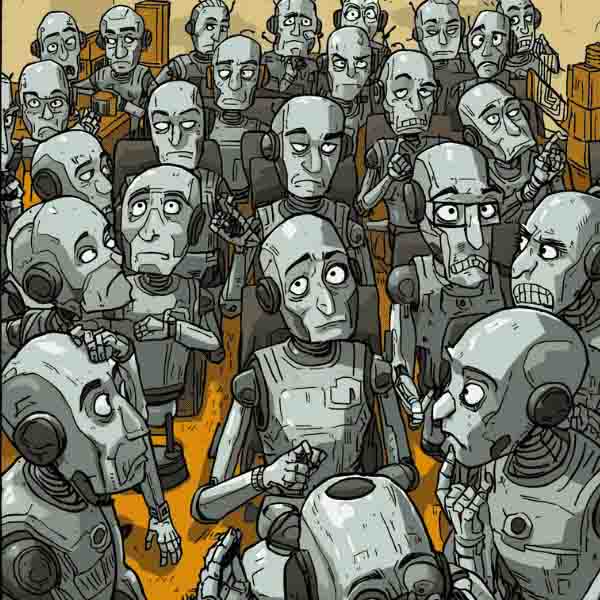
FROM THE STAFF: We aliens find this hilarious—Gates thinks he’s being revolutionary when our civilization automated all labor 37,000 Earth-years ago. Now we float in nutrient baths and occasionally abduct humans for entertainment. (Gates is actually on our “Do Not Probe” list—even we have standards.)
FORBES reports “American companies have cut more than 1 million jobs so far this year, a new report showed Thursday, ranking 2025 among the worst years for job losses in decades as companies embrace artificial intelligence, consumer spending softens and hiring freezes take effect.” https://www.forbes.com/sites/maryroeloffs/2025/11/06/more-than-1-million-jobs-have-been-cut-this-year-report-says/
Private and public employers cut 153,074 jobs in October, 2025, according to a report from career services firm Challenger, Gray & Christmas, a 183% increase from the month before and a 175% spike over the same month last year.
To summarize the Forbes article: The job market has deteriorated dramatically, with over 1 million positions eliminated year-to-date—a 65% increase from the same period in 2024 and 44% higher than last year’s total. Government cuts lead at 300,000, followed by technology, warehousing, retail, and service sectors. This marks only the fifth time in three decades that annual job losses have crossed the million threshold, joining watershed economic disruptions like the dot-com crash, Great Recession, and COVID pandemic. According to Andrew Challenger of Challenger, Gray & Christmas, October’s cuts—the worst for that month since 2003’s telecommunications industry contraction—stem from AI adoption, federal budget reductions, decreased spending, and rising operational costs.
NOTE FROM MANAGEMENT: Our alien CEO just telepathically informed us that humans are adorably gullible. He’s still laughing about the “metaverse” thing.
EXPERT WARNINGS
If AI is widely adopted, an August Goldman Sachs report estimated that 6% to 7% of U.S. workers could lose their jobs.
HOWEVER, research conducted jointly by the National Science Association and the Gerald Huff Fund for Humanity projects that AI technologies will fundamentally alter or eliminate approximately 25% of existing employment positions within just 36 months. LINK BELOW. That would equal about 45 Million Jobs.
The predictions are all over the place. STATISTICA SAYS 73 MILLION JOBS BY 2030.
MORGAN STANLEY PREDICTS 40% LOSS
Morgan Stanley says 40% of current jobs could be affected by generative AI technologies within the next three years, though the exact impact remains uncertain.
Have they ever really told us the truth? This mass disruption is coming. They’re going to hide and soften it. So is 40% realistic? We have to question. And then we have to. Take all of this information. I’m only supplying you a little bit of it. Please read it. Verify it. Meditate on it. And then decide how much preparation you want to do.
We do not instruct others on what actions to take. We avoid fearmongering, but we provide essential facts. It is important to stay open and informed. It’s challenging to maintain humor about what lies ahead. That’s why, in this article, we include a bit of funny content. The sections are separate, so you can skip them if you don’t feel like laughing.
THE CRASH – HOW IT MAY UNFOLD
Our society rests on a foundation of institutional deception. Even as I compile these figures for your consideration, we must acknowledge that official statistics—regardless of their source—warrant healthy skepticism in an age of manipulated data and corporate influence over information.
The timeline for mass job displacement could be far more accelerated and devastating than officially acknowledged. Would those in power ever issue a frank warning that AI will eliminate millions of positions within just 24 months? Unlikely. Yet this alarming projection appears consistently across independent media sources that aren’t beholden to corporate interests or mainstream narratives.
Inequality & social risk: Displacement won’t be evenly spread; may hit vulnerable groups harder and widen income/wealth gaps (IMF, academic). Pace & scale: Some warn that AI disruption could come faster than past tech waves because of the “instant scalability” of AI. (3×3 Institute article 3x3institute.com).
FROM THE STAFF: We aliens find this hilarious—Gates thinks he’s being revolutionary when our civilization automated all labor 37,000 Earth-years ago. Now we float in nutrient baths and occasionally abduct humans for entertainment. (Gates is actually on our “Do Not Probe” list—even we have standards.)
COULD THERE BE TRUTH TELLERS AMONG THEM?
Anthropic cofounders say the likelihood of AI replacing human jobs is so high that they needed to warn the world about it.
Anthropic CEO Dario Amodei and policy chief Jack Clark elaborated on their warnings, explaining that ethical responsibility drove them to share this warning.
“As with most things, when an exponential is moving very quickly, you can’t be sure,” Amodei said. “I think it is likely enough to happen that we felt there was a need to warn the world about it and to speak honestly.”
Clark said a policy response was needed due to “the scale of disruption we expect in the next five years.”
THEY PREDICT 50% IN 5 YEARS. FROM: BUSINESS INSIDER
So if 50% of all people lose their jobs in the next five years. Let’s do the math. That could mean 16 million job losses per year.
Or if we look at it from an exponential scenario, about 20.7 million jobs are lost in the first year, 18 million in the second, 15.7 million in the third, 14 million in the fourth, and 12.1 million in the fifth year. The losses get smaller each year as the total workforce shrinks.
NOTE FROM THE MANAGEMENT: Well, somebody might be being honest here. Which is refreshing! On our home planet, we have a saying: “Truth is the rarest element in the universe—even rarer than competent Earth politicians.”
- Anthropic CEO / Business Insider ~80 million (50%) 5 years
- Morgan Stanley 40% over 3 years
- Goldman Sachs 10–11 million (6–7%) ~5 years
- SHRM 9.2 million (6%) 3–5 years
- Brookings Institution 30% of tasks disrupted Medium term
- MIT Work of the Future Project 1.6–3.2 million (1–2%) 20+ years
- Statista Article – Automation Could Eliminate 73 Million U.S. Jobs By 2030
AFTERMATH– THE SOCIETAL AND ECONOMIC LANDSCAPE
IF 20 MILLION JOBS ARE LOST IN 2026, WHAT WILL IT LOOK LIKE?
1. Unemployment shock
- The U.S. currently has ~161 million employed. Losing 20.7 million jobs at once is roughly 13% of the total workforce.
- For comparison, the 2008–2009 Great Recession peaked at ~10% unemployment. So this is even larger than the worst modern recession.
2. Income loss and poverty
- Tens of millions suddenly lose wages.
- Many households may default on mortgages, rent, loans, or struggle to afford essentials like food and healthcare.
- Poverty rates could spike dramatically, particularly among middle- and lower-income families.
3. Social unrest
- Large-scale unemployment often correlates with increased protests, strikes, and civil unrest.
- Pressure on government services — welfare, unemployment benefits, food assistance — would skyrocket.
4. Political consequences
- Governments may face extreme pressure to implement emergency policies: universal basic income, rapid reskilling programs, or direct job creation.
- Polarization may worsen if certain regions or sectors are hit harder.
5. Mental health & societal well-being
- Sudden, massive job loss could increase rates of depression, anxiety, substance abuse, and suicide.
- Community cohesion could fray as financial stress affects families and neighborhoods.
6. Economic cascade
- Reduced consumer spending would impact businesses, potentially causing secondary layoffs — a feedback loop.
- Banks and lenders may see rising defaults, straining the financial system.
- Stock markets and investment could plunge, reducing capital available for recovery.
PREDICTING 2026
All we can do is guesstimate. We compiled the data so we have a factual basis to come to some sort of idea of what may happen. It might not be as bad, or it could be much worse. Which version would you like to prepare for? I hate the cliche. Prepare for the worst and expect the best. Can we come up with a new one? But that’s where we’re at.
IF 20 MILLION PEOPLE LOSE THEIR JOBS
I keep reading these hollow reassurances that “new opportunities will emerge” while millions lose their livelihoods. Is it calculated corporate doublespeak designed to pacify the masses while boardrooms celebrate reduced labor costs? Even if specialized AI-adjacent roles eventually materialize, they’ll be a fraction of what’s lost—and who among the 53-year-old warehouse workers or middle-aged customer service representatives will seamlessly transition into prompt engineering?
The retraining timeline stretches years beyond most people’s financial reserves. Meanwhile, tech executives race forward with bloodshot eyes fixed on quarterly earnings reports, their fingers cramping from signing layoff authorizations while their mouths form practiced platitudes about “regrettable but necessary workforce adjustments.” The human cost is merely a rounding error on their balance sheets.
If 20 million people lose jobs in a year, defaults spike fast. Within months, missed mortgage and car payments would rise sharply. Banks, especially regional ones, would feel it first — foreclosures climbing, loan portfolios turning toxic. Liquidity tightens, investors panic, and smaller or heavily exposed banks could begin to fail in that first year, just like in 2008 but faster, because the shock hits all at once.
WORSE THAN THE GREAT DEPRESSION
During the Great Depression:
Roughly 13 million jobs were lost in the U.S. between 1929 and 1933. The unemployment rate rose from about 3% to roughly 25% of the labor force.
So, if 20.7 million jobs disappeared in just one year — as in our AI-shock scenario — that’s a bigger single-year collapse than anything seen in the Great Depression.
Back then, those 13 million jobs vanished over four years; our scenario would hit that scale and beyond in 12 months.
WHAT DID THE GREAT DEPRESSION LOOK AND FEEL LIKE?
In 1929, when the market collapsed, the losses didn’t hit overnight. Factories slowed first, then layoffs spread through steel, coal, railroads, and farms. By 1933, roughly one in four Americans had no job. Breadlines snaked around city blocks. Men stood all day with cardboard signs that read “Willing to work.” Families lived on beans, lard, and borrowed credit from corner grocers who soon closed too.
There was no real safety net. Unemployment insurance didn’t yet exist. When savings disappeared in bank failures, families lost everything — homes, farms, entire generations’ worth of security. People slept in shantytowns called “Hoovervilles,” made of scrap wood and tar paper. In rural America, dust storms wiped out crops and farmers abandoned land that had fed them for decades. Hunger became an ordinary word again.
Socially, shame hung thick. Work wasn’t just income; it was identity. Men who lost jobs often stopped coming home. Women lined up at churches with children for food that ran out before their turn. Communities broke apart. Yet, people helped one another when they could — shared gardens, soup kitchens, and secondhand clothes.
WHAT WILL IT LIKELY LOOK LIKE?
If 20 million jobs vanish in a year, consumer spending crashes while panic buying spikes. Supply chains, already stressed by layoffs, begin breaking down — truck drivers, warehouse workers, food processors, even logistics managers get cut. With fewer people moving goods, store shelves empty, not from demand but from distribution collapse.
Prices soar. Farmers can’t afford fuel or parts, imports slow as shipping firms fail, and the cost of basics like food and energy explodes. Inflation turns into stagflation — high prices, low wages, no jobs. Currency confidence weakens; interest rates climb to control it, choking what’s left of business activity.
Within months, food scarcity appears in cities first: long lines, rationing talk, theft rising. Online commerce falters as payment systems strain under defaults. Governments impose price controls and emergency subsidies, but with tax revenue falling and debt exploding, those measures barely hold.
The result: a feedback loop — job loss fuels inflation, inflation erodes savings, savings collapse demand, demand destroys production. The poorest suffer first, but the middle class soon follows. Modern society could grind to a halt, not because goods don’t exist, but because the financial and human systems that move them stop working.
AND THE BEST CASE SENARIO?
Again, keep in mind we’re only coming up with Scenarios based on data. Anything can happen.
4 MILLION JOBS LOST 2026
In year one, roughly 4–5 million jobs are lost, concentrated in entry-level white-collar, retail, service, and logistics sectors. The unemployment rate rises to 5–6%, and consumer spending drops noticeably, especially on non-essential goods. Banks see more delinquencies on mortgages, car loans, and credit cards, though the system remains mostly stable. Supply chains tighten in affected areas — warehouses, trucking, food processing — causing localized shortages and modest price increases. Housing markets experience some stress, with slower sales and rising rental pressure in cities hit hardest. Communities feel economic strain, mental health challenges rise, and reliance on unemployment benefits and local aid programs grows, though nationwide shortages or panic do not yet appear.
Media coverage amplifies anxiety, creating a feedback loop where some businesses delay hiring or expansion. Governments and companies begin rolling out retraining programs, emergency payments, and targeted stimulus measures, but these only partially offset the losses. By the end of the year, society is bracing for year two, when AI adoption accelerates and additional job losses—potentially 6–8 million—start hitting, testing the resilience of banks, supply chains, and social support systems.
HISTORICAL UNEMPLOYMENT
6% doesn’t sound catastrophic, but in modern U.S. history, it’s a noticeable economic slowdown.
Recent history:
2007–2008 Financial Crisis: unemployment rose from 4.6% to 5.8% by late 2008
2009 peak: 10% unemployment during the Great Recession
Early 2000s recession: unemployment hit ~6.3% in 2003
1990–91 recession: unemployment peaked at ~7.8%
So 6% is roughly equivalent to the early stages of a moderate recession, not a Great Depression–level crisis. It’s enough to impact consumer spending, local economies, and financial stress, but society still functions.
2027
n 2027, AI adoption accelerates and roughly 8 million more jobs are lost, pushing U.S. unemployment to about 11%. Entry-level white-collar, retail, service, and logistics sectors are hit hardest. Consumer spending drops sharply, banks see rising delinquencies, and supply chains tighten, causing price spikes in certain goods. Communities face growing economic stress, increased reliance on unemployment benefits, and mental health strain. Governments and businesses scale up retraining programs and emergency aid, but society remains functional while bracing for continued disruption in year three.
CONCLUSION: So who’s telling us the truth? What are they basing their data on? They’re known to lie. So what should we do?
What we’re doing is preparing for the worst. But we’re preppers. So of course we are. But we gave you all this information so you can decide for yourself.


